
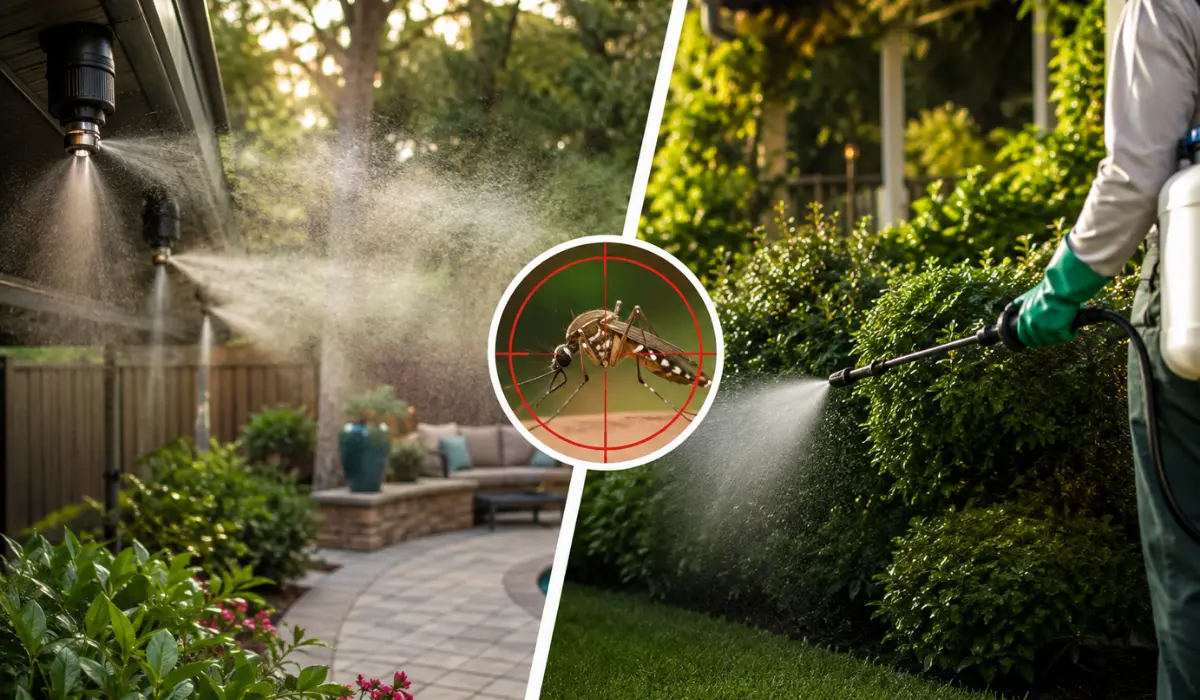
What Makes Mosquito Misting Systems Different From Conventional Outdoor Pest Spraying?
Backyard mosquito control splits into two camps. One depends on scheduled technician visits. The other installs permanent nozzles along fence lines and eaves. Homeowners weighing boerne pest control options rarely hear how far apart the two methods sit. Timing, coverage, chemistry, and upkeep all diverge. What follows compares automated misting hardware against conventional outdoor spraying, including pollinator risk, maintenance load, and the conditions where each approach falls short.
Fixed Nozzles Replace The Technician Visit
Misting setups run on installed plumbing. Tubing threads along fences, soffits, and planting beds. A reservoir pumps diluted insecticide out through dozens of small heads. Conventional treatment arrives in a backpack sprayer instead. One method gets built into a property; the other simply visits it.
Why Does Spray Timing Matter So Much?
Timers release product two to four times daily. Mosquito activity, though, swings with heat, wind, and recent rain. Cycles keep firing when no insects are present. A barrier application leaves residue on leaf undersides, which holds its potency for roughly three weeks.
Coverage Patterns Diverge Across The Yard
Mist drifts outward from fixed lines, so protection clusters near the hardware. A barrier round from boerne pest control crews reaches resting spots across the full lot.
- Technicians coat shrub undersides where adults shelter
- Dense ivy and fence bases get direct attention
- Standing water receives larvicide, cutting the next generation
- Open mowed turf gets skipped on purpose

What Happens To Bees And Butterflies?
Pyrethrins kill any insect contacted, not mosquitoes alone. Automated units discharge day and night, exactly when pollinators forage. A person holding the wand can steer around blooming lantana. Trained judgment has no software equivalent.
Upkeep Demands Separate The Two Methods
Installed equipment carries obligations that spray service avoids.
- Clogged nozzles throw uneven patterns
- Reservoirs need refilling each season
- Freezing nights can crack tubing
- Gusts push mist off target
A recurring barrier program moves that burden onto the provider entirely.
Hardware Buys Convenience, Not Judgment
Nozzles firing at dawn cannot tell a mosquito from a bumblebee. That blind spot explains why entomologists favor scheduled applications paired with breeding-site removal. Misting answers a convenience problem rather than a biology one. Properties with heavy evening use and sparse pollinator planting may still justify the investment. For most lots, the decision belongs to a person, not a timer.
FAQs
How long does one barrier treatment last?
Most professional applications stay effective for about three weeks. Heavy rainfall shortly after service shortens that window considerably.
Can a misting system be turned off manually?
Yes, most units include a remote or switch for skipping cycles. Owners often pause them during gatherings or high wind.
Does either method eliminate breeding sites?
Neither does so on its own. Clogged gutters, saucers, and tarps still need draining between treatments.
Which option costs more over five years?
Installation and equipment push misting higher upfront. Recurring spray visits accumulate steadily, so the gap narrows across long ownership.

